
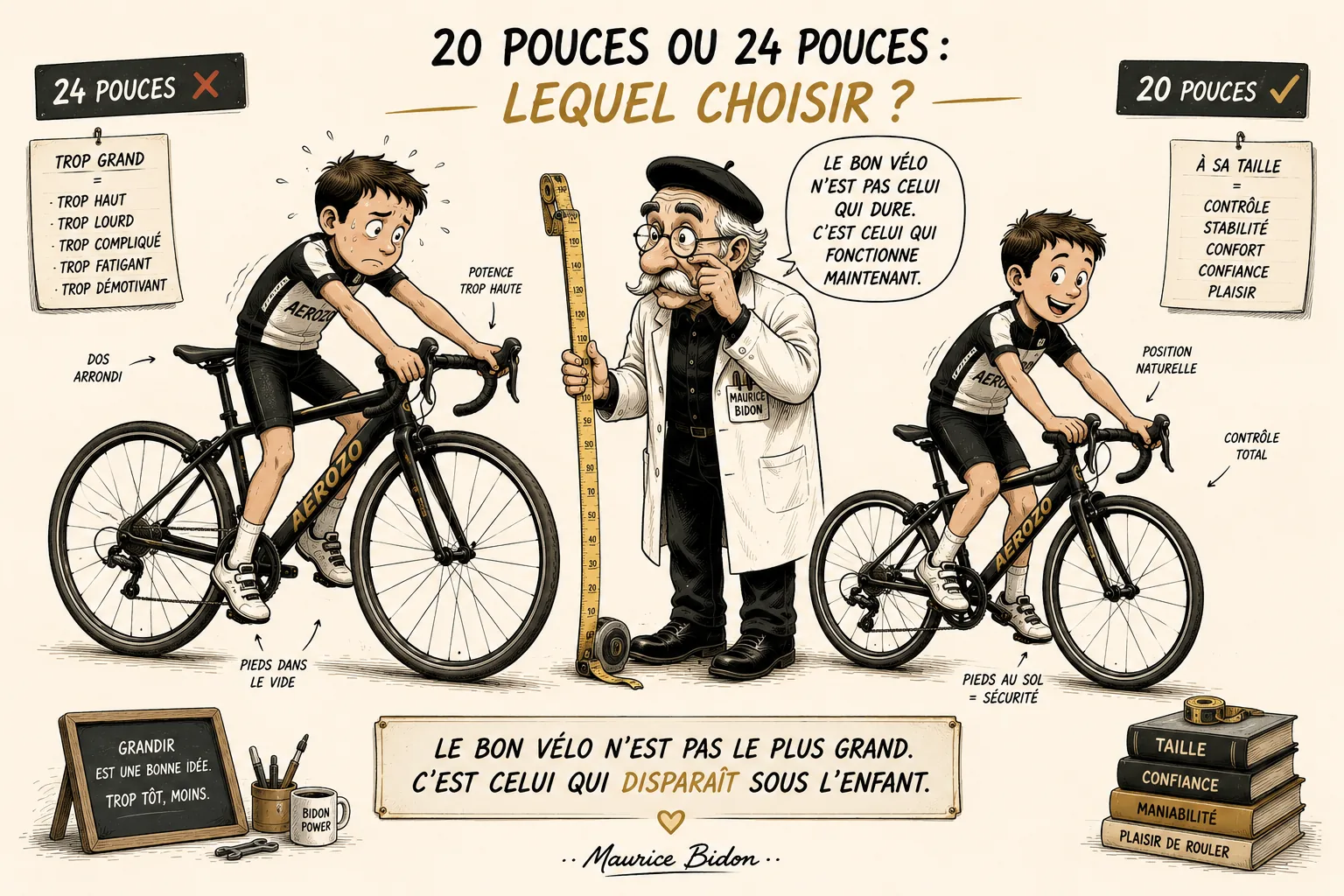
Between 20-inch and 24-inch bikes, many parents hesitate. And very often, the temptation is strong: choose bigger so it lasts longer.
On paper, it sounds logical. In real life, a bike that is too large can quickly turn a fun ride into a balancing act.
The trap of the oversized bike
An oversized bike often reassures adults. It creates the feeling of a “smart”, long-term and cost-effective purchase. But children are not riding in two years. They are riding today.
And today, if the bike is too tall, too long or too difficult to control, children will compensate. They stretch their arms, search for balance points, hesitate while braking and lose confidence.
Sometimes people think they are buying longevity. They are mostly buying bigger problems.
What size truly changes
The size of a bike changes everything:
- the child’s position,
- their ability to brake easily,
- their confidence in corners,
- handling,
- comfort,
- and the desire to keep riding.
A bike that is too large does not make children bigger. It mostly makes their movements less natural.
Why 20-inch can be the right choice
A good 20-inch bike should not be seen as a “small bike while waiting for better.” It can be the truly right bike at the right moment.
When properly designed, it immediately allows children to feel freer: feet closer to the ground, accessible cockpit, more natural braking and easier reactions to understand.
And that changes everything. Because children who control their bike gain confidence. And children gaining confidence ride more often, for longer and with more enjoyment.
When should children move to 24-inch?
Moving to a 24-inch bike should not depend only on age. Two children of the same age can have very different sizes, body proportions, ease and physical maturity.
The right moment comes when children are truly ready: when they keep a natural position, brake effortlessly, control the bike without tension and no longer look “placed on top of” the bike but integrated into it.
A 24-inch bike can be an excellent choice. But not too early. Not out of anticipation. Not only because it looks more serious.
The real criterion: confidence
A properly adapted bike provides something technical sheets rarely measure: immediate confidence.
You can see that confidence. Children look ahead. They corner more naturally. They brake with less hesitation. They accelerate without struggling. They stop thinking about the bike: they simply ride.
And that is exactly what we are looking for.
At AEROZO
At AEROZO, we wanted to make the 20-inch bike a true junior road bike, not a default transition step.
A bike capable of delivering true road-bike sensations while remaining coherent with the size, strength and confidence of young riders.
Because children do not need a bigger bike to feel like cyclists. They need a bike allowing them to feel good right now.
The right choice
Choosing between 20-inch and 24-inch is not choosing between “small” and “big.” It is choosing between “adapted” and “too early.”
And very often, the best bike is the one immediately making children want to ride. Not the one promising to be useful later.
Former unofficial tailor of oversized bikes, specialist in children hanging above frames “so it lasts longer.”