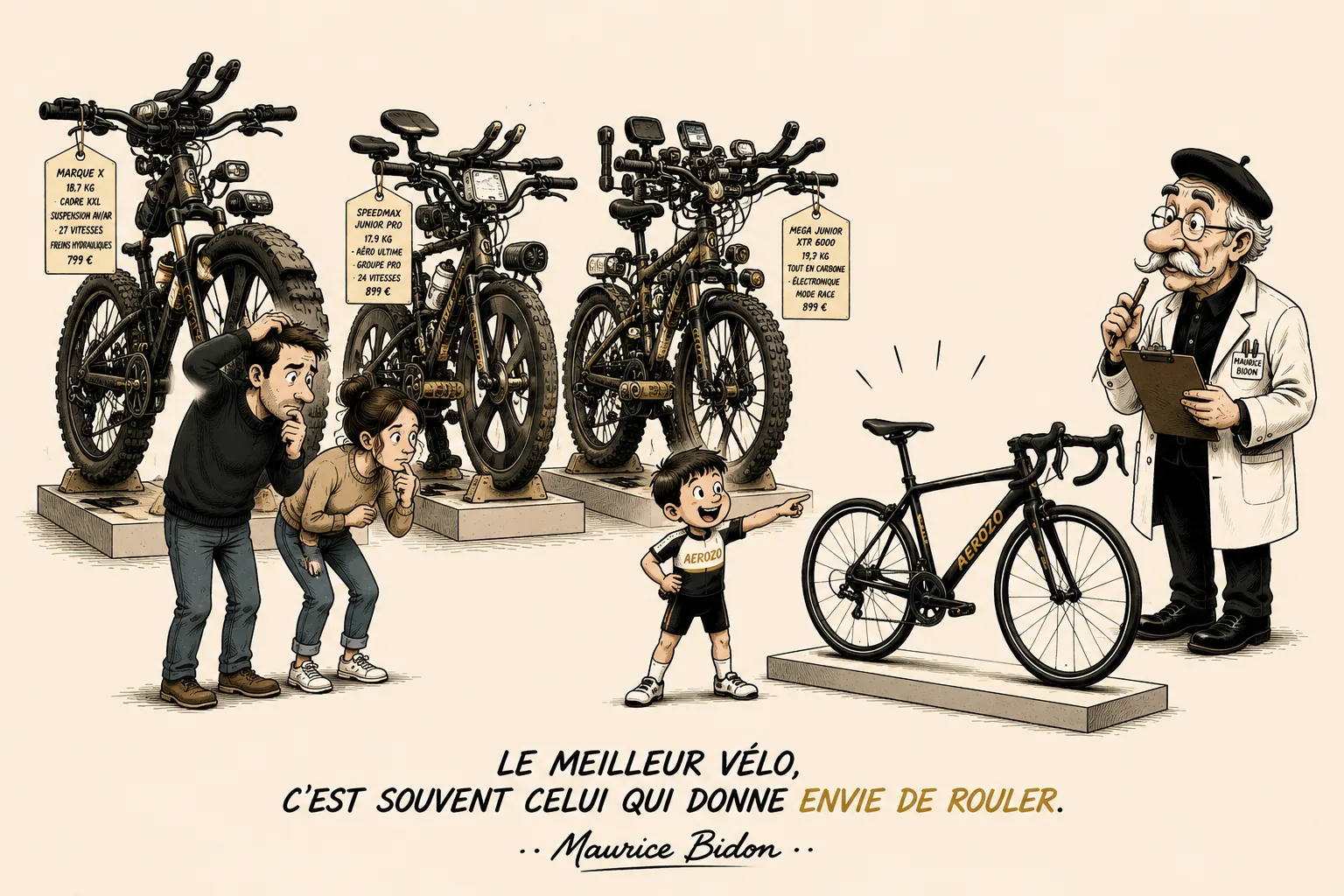
Choosing a road bike for children should be simple. In theory. In reality, many parents face sizes, weights, promises, components, prices and marketing speeches that sometimes make it feel like choosing a connected boiler.
And in the middle of all this, there is the child. The one who does not read specification sheets. The one who does not compare groupsets. The one who does not ask whether the bike will still be “worth it at 16.” They simply look at the bike and ask one much simpler question: do I actually want to ride it?
Mistake number 1: choosing too large
The classic mistake. Buying a bike “so it lasts longer.” On paper, it sounds rational. In reality, it is often the beginning of problems.
A bike that is too large makes children less comfortable, less precise and less confident. They brake less naturally, corner with more hesitation and compensate for a position that does not truly belong to them.
A child’s bike is not a winter coat bought one size too large. It is a learning tool. And to learn properly, children need the right position from the start.
Mistake number 2: forgetting weight
A heavy bike for adults is annoying. A heavy bike for children can be discouraging.
Because one kilogram does not mean the same thing for every rider. A 25 kg child riding a bike that is too heavy feels every acceleration, every climb, every U-turn and every stop.
Weight is not just there to look good on a product sheet. It directly influences enjoyment, fatigue and the desire to ride again.
Mistake number 3: confusing technical with useful
In cycling, we sometimes love adding complexity. More gears, more options, more promises and more complicated words.
But children do not need a bike that impresses adults. They need a bike they understand, control and can use naturally.
- Accessible brake levers matter more than marketing speeches.
- A natural position matters more than an aggressive look.
- Proper gearing matters more than an impressive number of gears.
- A fluid bike matters more than an “over-equipped” one.
What truly matters
A good road bike for children should be judged on very concrete criteria:
- the child’s actual size,
- their position on the bike,
- their ability to brake easily,
- the bike’s total weight,
- handling,
- the feeling of confidence.
The right bike is not the one looking most serious in a comparison table. It is the one that naturally makes children feel more comfortable.
Enjoyment is not a detail
For children, enjoyment is not a bonus. It is the foundation of everything.
Children who enjoy riding improve. They dare more. They try again. They want to follow, experiment, accelerate, corner, descend and start again. On the other hand, children placed badly on a bike that is too heavy or too complicated may quickly believe they “do not like road cycling.”
When sometimes, they simply do not like the wrong bike.
At AEROZO
We wanted to create a bike that speaks first to children without betraying the passion of adults.
A bike with a true road-bike silhouette, a true sporting identity and real visual appeal. But also a bike designed for the size, strength, position, balance and enjoyment of young cyclists.
Because children can dream about beautiful bikes. They can want a bike that looks like the ones adults ride. But they should never pay for that dream with an impossible position, absurd weight or unnecessary complexity.
The right choice
Choosing a road bike for children is not about finding the most spectacular bike. It is about finding the one that will make children want to ride again tomorrow.
And that is often where everything happens: a bike with the right size, light enough, easy to understand, enjoyable to ride and beautiful to look at.
Because ultimately, the best children’s bike is not the one promising the most. It is the one that makes children want to go ride.
Former unofficial advisor to parents lost in specification sheets, specialist in bikes chosen like household appliances.