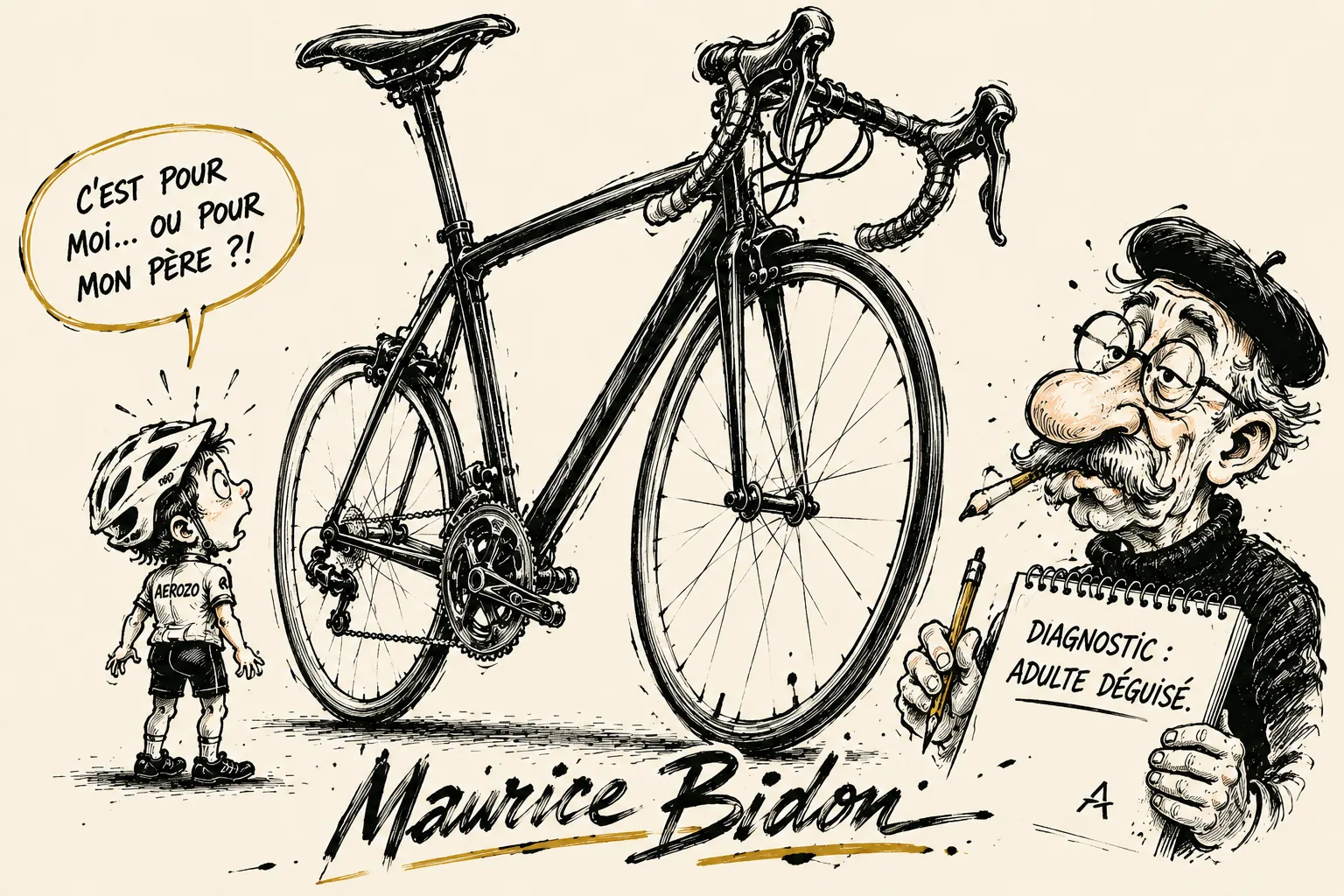
For years, the children’s bike industry followed a method of scientific precision: take an adult bike, shrink it in the dryer, remove a few centimeters everywhere, add flashy colors, then write “junior” on it.
On paper, it almost sounds logical. In reality, it often means children perched on bikes that are too big, too long and too heavy, with brake levers they reach for as if they were trying to recover a TV remote lost behind the couch.
Children do not ride like adults
Adults can compensate for many things: an average position, a bike that is slightly too long, poor gearing or an overly demanding cockpit. They compensate with strength, experience, core stability and sometimes with the ego of a weekend cyclist dressed entirely in black lycra.
Children cannot fake it. If the bike is poorly adapted, they feel it immediately. They tire faster, hesitate more, brake less efficiently, corner with less confidence and often end up saying they “do not really like road cycling.” In reality, they simply do not enjoy fighting against a machine designed for someone else.
Geometry changes everything
Geometry is not just a collection of numbers for people who pronounce “reach” far too seriously. It defines how a child feels on the bike.
- A position that is too long creates fatigue and limits handling.
- A cockpit that is too high or too low destroys confidence.
- A poorly proportioned frame makes the bike feel unnatural.
- A poorly positioned child does not progress: they compensate.
A true junior bike should allow children to ride naturally. Not silently adapt to a design mistake.
Weight: the classic mistake
Adults can debate for three hours to save 70 grams on a stem. Yet for children, we still see bikes whose weight represents a huge proportion of the rider’s own body weight.
One kilogram on a child’s bike does not have the same impact as one kilogram on an adult bike. For a young rider, every gram is felt in accelerations, climbs, direction changes and overall fatigue.
A child’s bike should not feel like towing a miniature caravan. It should make children want to ride again.
Components must speak the language of children
A true junior bike is not just a small frame. The cockpit, levers, cranks, gearing, braking and wheels must all answer one simple question: can a child actually use them with enjoyment and control?
A brake lever that is too far away is not a detail. Gearing that is too hard is not “educational.” An overextended position is not “sporty.” It is simply poorly adapted.
Confidence before performance
For children, performance comes after confidence. A child who feels comfortable dares to corner, brake, accelerate, follow, try and start again. They improve because they enjoy it.
And that is probably the most important thing: the right bike is not necessarily the one promising the most performance. It is the one that makes children want to ride again tomorrow.
At AEROZO
We started from a simple idea: children deserve better than a miniature adult bike. They deserve true engineering, true geometry, true road-bike behavior and an experience designed for their size, strength, balance and enjoyment.
A junior bike should not be a compromise. It should be a starting point. The one that builds confidence. The one that creates desire. The one that turns a first ride into a memory.
Former anti-time-trial rider and self-proclaimed specialist in bikes that are too large, too heavy and far too serious.