In the world of junior bikes, there's a phrase you hear all the time: "It's fine, it's a kids' bike."
As if simply reducing the size were enough to make the bike suitable. As if a smaller frame, two smaller wheels and a slightly dynamic colour automatically transformed the object into a proper junior bike.
Unfortunately, it's not that straightforward.
Mistake no.1: the bike that's too big
This is probably the most common one.
You choose a bike that's "a bit big" because the child will grow. On paper, it's economical. On the road, it's often a very bad idea.
A bike that's too big forces a poor position, complicates braking, makes handling less natural and immediately kills confidence. The child stops enjoying the bike. They're mostly just trying to manage it.
And no, "they'll get used to it" is not a product development strategy.
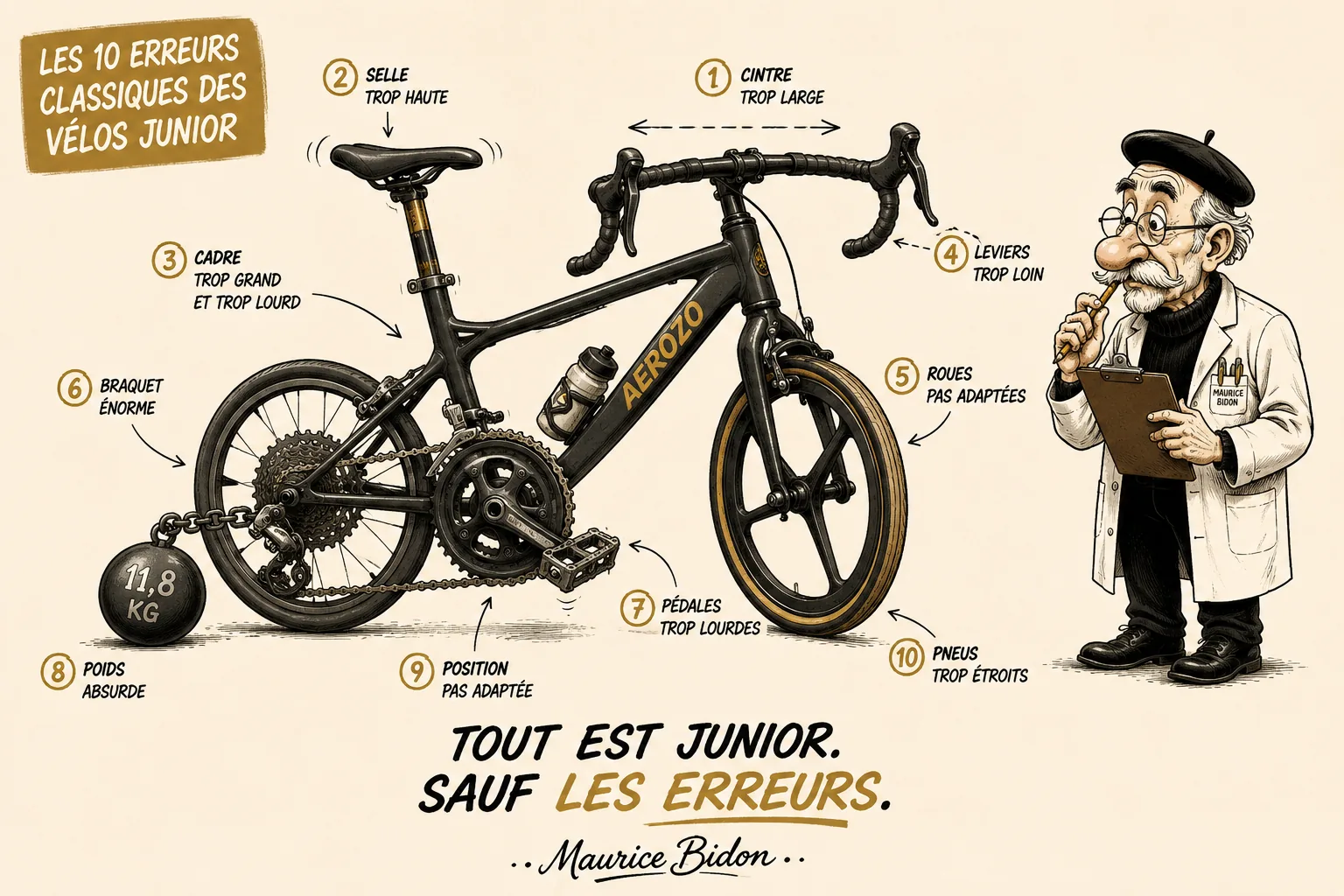
Mistake no.2: the miniaturised adult cockpit
A child doesn't have the shoulders, hands, arms or range of movement of an adult. Yet many junior bikes still feature cockpits that demand too much reach, too much strength or too much adaptation.
- A handlebar that's too wide blocks the position.
- Levers that are too far away make braking difficult.
- A position that's too stretched causes unnecessary fatigue.
- A poorly designed cockpit makes the bike feel less reassuring.
A junior cockpit should be accessible, natural and obvious. Not give the impression that the child is trying to pilot a plane with arms that are too short.
Mistake no.3: underestimating weight
On an adult bike, an extra kilogram can be annoying. On a children's bike, it can completely transform the experience.
Because a 25 kg child on a bike that's too heavy has a completely different experience from a 75 kg adult on a 9 kg bike. The weight ratio is brutal. Accelerations are harder, climbs are longer, manoeuvres are more tiring.
A junior bike that's too heavy isn't just a bike that's "slightly less performant". It's a bike that can take away the enjoyment.
Mistake no.4: professional climber gearing
Some children's bikes sometimes give the impression of having been designed for an angry adult on a mountain training camp.
The gearing ratio must be consistent with the child's strength. Gearing that's too hard breaks cadence, causes quick fatigue and makes accelerations uncomfortable.
A young cyclist should be able to pedal fluidly. Not fight against a drivetrain that tells them, from the very first climb, that life is suffering.
Mistake no.5: wheels that don't talk to the road
Wheels have an enormous influence on how a bike behaves: stability, fluidity, efficiency, confidence. Yet they are often treated as a detail.
Poorly adapted wheels can make a bike too nervous, too sluggish or too unnatural. The bike can then look like a road bike visually, without truly offering a real road feel.
On a child, this difference is felt very quickly. They won't describe it in technical terms. They'll simply say: "It doesn't move", "It's hard" or "I don't really like it".
Mistake no.6: confusing solid with oversized
Of course a children's bike needs to be reliable. Of course it needs to withstand use, handling, small errors and real life.
But "solid" shouldn't mean massive, heavy, rigid or completely oversized.
The right balance is a reliable bike without becoming an anvil. A reassuring bike without becoming sluggish. A bike built to last without discouraging the person who has to make it move.
Mistake no.7: forgetting enjoyment
This is the most important one.
In the junior bike world, people often talk about size, components, weight, drivetrain, wheels. All of that matters. But the real objective remains simple: make you want to ride.
A child who enjoys themselves progresses naturally. They dare more, ride more, come back more willingly. Conversely, a poorly designed bike can quickly turn the road into a chore.
At AEROZO
We believe that a junior bike should not be a collection of compromises.
It should be coherent as a whole: geometry, wheels, cockpit, braking, drivetrain, weight and feel. Every choice should answer the same question: does this genuinely help a child ride with confidence and enjoyment?
Because at the end of the day, the right junior bike isn't the one that looks most like an adult bike. It's the one that gives the child the feeling that the road was made for them.
Self-proclaimed inspector of Frankenstein bikes, specialist in handlebars that are too wide, saddles that are too high and mistakes that are far too classic.