In junior cycling, there is one subject almost nobody talks about. Yet it influences absolutely everything: stability, handling, efficiency, fluidity, enjoyment and confidence.
That subject is wheel diameter.
Yes. Wheels.
Said like that, it sounds about as exciting as a tax debate on television. But in reality, it is probably one of the most important elements in the behavior of a junior road bike.
The “20-inch” problem
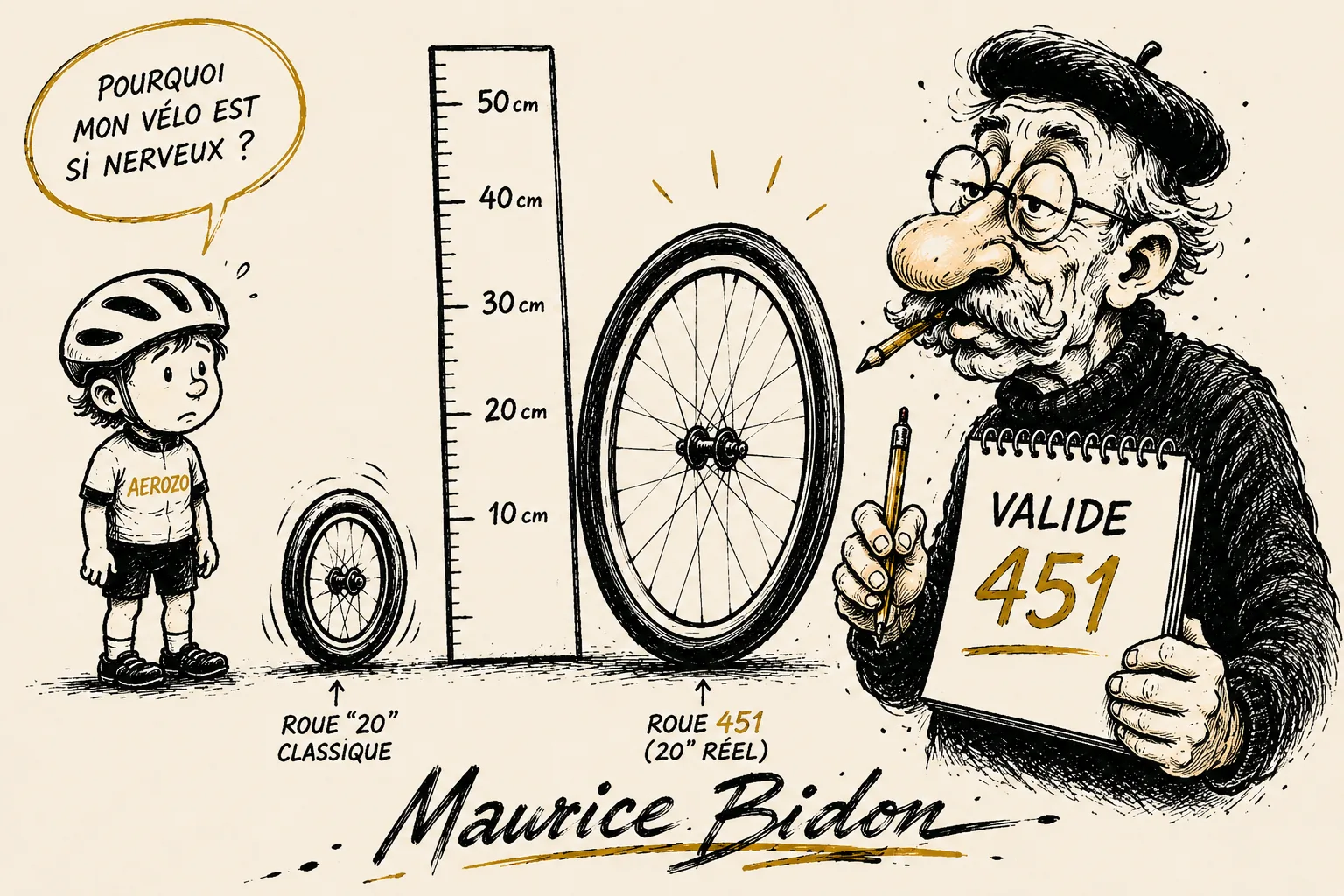
In children’s cycling, many completely different wheels are grouped under the same name: “20-inch.”
In practice, however, two bikes advertised as “20-inch” can behave in completely opposite ways. One can deliver a true road-bike feeling, while the other can feel like steering a shopping cart down a parking ramp.
And for a child, this is not a detail. Young riders instantly feel whether their bike is stable, fluid, lively… or simply strange.
Small wheels change behavior
The smaller the wheel:
- the faster it loses speed,
- the more nervous it becomes,
- the more abruptly it reacts,
- the more it “falls” into imperfections in the road.
As a result, the bike feels more restless, less fluid and less natural.
For an experienced adult, this may not be dramatic. For a child, however, it changes everything. Children do not compensate with power, experience and twenty years of Sunday club rides.
Why the 451 format?
The 451 format creates a wheel that rolls faster, feels more stable, smoother and preserves speed better.
The bike immediately becomes calmer, more natural and more “road-bike.” That is exactly what we were looking for at AEROZO.
- More stability through corners.
- More fluid acceleration.
- A better sensation of speed.
- A healthier behavior for learning.
And what about the tires?
A good wheel with a bad tire is still a bad combination. It is like wearing ski boots to run a 100-meter sprint: technically you move forward, but nobody should approve that.
At AEROZO, we wanted to preserve liveliness, efficiency and a true road-bike feeling without making the bike feel heavy.
That is precisely why we chose the Kenda K1018 in 23 mm.
Why Kenda K1018 tires in 23 mm?
Because they deliver exactly what we were looking for: a lively behavior.
Not a hybrid tire. Not a disguised BMX tire. Not an oversized tire supposedly meant to reassure riders but ultimately making the bike soft, heavy and slow.
The 23 mm setup provides:
- more precise steering,
- more dynamism,
- a more authentic road-bike feeling,
- a more playful bike.
Today, in adult cycling, some tires have become so wide that you start wondering whether the bike is about to plow a field. But on a junior bike, the subject is completely different: children weigh less, ride slower, apply fewer forces and above all need a bike that responds easily.
And honestly, when a child starts accelerating simply because they find it fun, you usually know you are on the right path.
The real subject: sensations
For adults, cycling sometimes becomes an accumulation of numbers, watts, spreadsheets and endless debates about 38 grams.
For children, the subject is much simpler: the bike must make them want to ride.
Wheels play a massive role in that feeling of fluidity, speed, ease and enjoyment. A good junior bike should almost feel like it moves forward on its own.
At AEROZO
The choice of 451 wheels paired with Kenda K1018 23 mm tires was part of the project from the very beginning.
Not to look good on a spec sheet. Not to tick a “performance” box. But because this choice genuinely transforms the bike’s behavior: more stable, smoother, more precise and more lively.
Because ultimately, children also deserve a bike that makes them want to accelerate simply for the pleasure of feeling the road flow beneath the wheels.
Former self-proclaimed specialist in nervous bikes, absurd wheels and diagnoses taken far too seriously.